SIZZLING SEMANA SANTA. Holy week in the Philippines usually falls on the peak of the summer months. Depending on the Catholic calendar, the movable feast of the Samana Santa is observed all over the country in between the weeks of March and April. It is a season when the days are longer, the weather is hotter and one wonders if planet Mercury was replaced by Pampanga as the closest place to the sun.
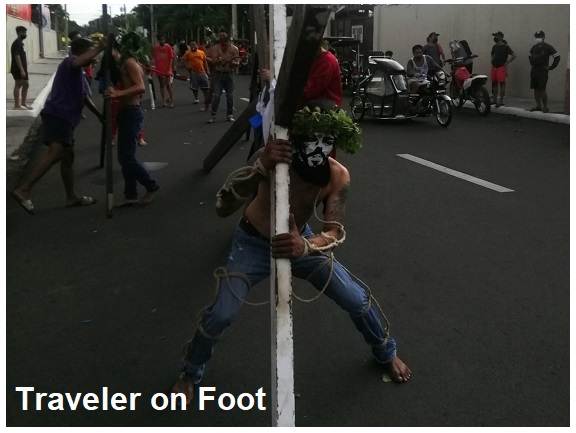
The moment I stepped out of the car in Dau, it felt like I entered into a preheated oven. But I forgot about the heat wave because this is a chance to witness up close and in the flesh a line of bloodied flagellantes doing this extreme ritual in this sizzling Semana Santa.
PENETENSIYA. Holy week rituals were handed down to generations of Filipinos through long ages of catechism instructions. I grew up in a household that prohibited playing of loud music and was admonished by elders when participating to any form of games that could inflict wounds throughout the holy week because of the belief that wounds wont heal like how they are depicted in the images of the suffering Christ.
Just as the same in the olden days, fasting, abstaining from meat, joining and exhausting savings to sponsor processions and spending longer hours praying in humid churches are still practiced by the devout Catholics up to this day. The Spanish friars in the seventeenth century, particularly the Jesuits and Franciscans introduced to the indios the penetensiya or physical mortification to repent of sins. According to sociologist, Fernando Nakpil-Zialcita bodily mortification were not alien practice among pagan Filipinos. Thus, Filipinos may have been convinced to flog themselves to honor the death of Christ (Cuaresma, 2000).
CRIMSON TRAIL. A sight to behold in rural towns are the flagellantes who beat themselves bloody to literally imitate the passion of Christ. Flogging themselves on the back with segments of bamboo at the end of a rope and whips embedded with splinters of broken glass, flagellantes form a crimson trail on the side of the road. They wear kapirosas or cotton cloth to mask up over which are shrubs or vines.
Flagellantes simulate Christ’s crucified position with arm spread and ankles crossed on the pavement right in front of makeshift chapels for the pabasa or on the church patio along the route. This practice of flagellation is not officially approved by the church that is why flagellants are not permitted to enter inside churches.
EPILOGUE: VERBATIM ET LITERATIM. The re-enaction of the way of the cross is repeated in various towns around the country and in different ways and intensity. But the gore and blood I witnessed on the roadside under Pampanga’s scorching summer sun is an extreme and verbatim interpretation one’s faith.
For the flagellantes, flagellation is a way of reciprocating God’s blessing with physical sacrifice.
MY PASSION FOR ASSEMBLAGE. As a passionate heritage and travel blogger, I amassed objects that touch on nostalgia and various aspects of culture from my sojourns over the past decade.
Just like how I woven my travel narratives and photo essays for my blog, I developed a passion for mixing unrelated objects and combining them in unexpected ways. These materials that I sourced from my travels become the corpus of my art: The Assemblage.
A DUO SHOW WITH THE EXPRESSIONIST MASTER. Custodian of Power Objects was staged in Altro Mondo Creative Space in Chino Roces Avenue, Makati City during the celebration of the National Arts Month in 2022. It was a dual art show I shared with the expressionist master Mario de Rivera that took inspiration from our individual travels and exchange of experiences with various cultures and heritage.
Mario is a fellow pilgrim and both of us enjoy telling stories about our experiences and encounters with the sacred, nostalgic and magical.
CURATED ARTIFACTS. For this show, I combined miniature relleves, retablos, rebultos and, reliquarios inside museum boxes and grouped them into mini-altars and make-shift shrines that blend well with Mario ‘s masterful mixed media layering of curated visual elements, themes and subjects from various historical timelines, cultures and mythologies.
These assemblage pieces are my reinterpretation of power objects that animistic societies and even up to the colonial period and the present time use them for healing, certain rituals, and believed to provide protection and sources of good luck.
WHAT’S IN THE SHOW. Power objects in different societies and historic periods can be in a form of natural or hand-made objects. During the pre-colonial era early Filipinos lived in animist societies. They believed that spirits reside in inanimate objects like rocks, rivers, caves and trees. The Ifugao for instance have 1,000 gods. They created gods that’s relevant to their farming activities and ancestor worship or anito.
The first Spanish colonizers came to the country via the sea as reflected in the painting of Mario, Ave Maria Stella. With the first missionaries were the Catholic religion and European culture that further enhanced the Filipino maximalist taste or horror vacuii.
HOW GODS ARE MADE. The assemblage How gods are made is designed to be a retablo or an altar that missionaries used as teaching aid about the Catholic faith and later the retablo, the cross and image of Christ and the objects carried during the Santacruzan procession became objects of veneration.
Local craftsmen were employed to paint and carve altars, religious statues and sacramentals. They haven’t been to Europe or had formal training in fine art, so the local artists copied from imported prints or images applying their own interpretation of the faith and inserting some images from their pre-colonial beliefs and practices like how the making of ex votos and anting-antings were developed.
THE VOTIVE CHAPEL. If you observe how the pieces were laid out in the exhibition space, one would think of a votive chapel with an altar as the focal point and stations like via crucis on the sides. Some spectators can also see this as curiosity cabinets, which in the 19th century were meant to showcase the world as recreated, reinterpreted and revealed by early travelers from the Age of Discovery.
I can say a lot about each of the pieces in this show, but my assemblage is open for a lot of interpretations. I hope that the viewers will dive and take a closer look at the objects and images used in the assemblage and find personal connection to the overall composition.
EPILOGUE: CUSTODIANS OF POWER OBJECTS. When spectators view this show it invites them to look back into history and heritage with nostalgia that make them realize that they too are custodians of power objects that can bring all that’s good into their lives and to others as well.
For inquiries about the artworks and catalogue for the show, please contact Altro Mondo Creative Space on Facebook (@altromondoart) or Instagram (@altromondoart). You can also message them via Viber or WhatsApp at 0917 888 7872. The gallery is in 1159 Chino Roces Avenue, San Antonio Village, Makati City. It is open from Tuesday to Saturday, 10am to 5pm.
AFTERNOON IN SAN NICOLAS. For countless of times, I’ve joined walking tours around the world’s oldest Chinatown to see the same old structures, sigh in frustration to notice the neglected ones and retrace the configuration of those that were demolished only to be repurposed as theme park attractions in a heritage resort by the sea. At an unhurried pace, I enjoyed piecing together like shards of broken ceramics popular history with narratives about unwritten heritage that has been passed down through generations by its early settlers to its current inhabitants.
Every trip has a different personality depending on who to go with. A decade ago, I joined Ivan Dy‘s iconic Big Binondo Food Wok for a heritage and culinary tour of Chinatown’s touristy zone and this was followed by random walking tours in the area during regular weekdays, Chinese New Year and Ghost Month. A year before the series of lockdowns and travel restrictions, Stephen Pamorada showed me around his heritage neighborhood in the San Nicolas District. Now fresh from a traveling hiatus, I’m back in San Nicolas this time with heritage champions Stephen, Rache Go, Benjamin Canapi and artists Kenny Tai and Jodi Aguillon.
THE LAST PARIAN DE LOS CHINOS. Binondo’s history can be traced to the 9th century when early Chinese traders sailed to Manila from Cathay in vessels to drop loads of valuable merchandise like silk and pottery and returned to their mainland laden with sugarcane, hemp, coconuts, and other local products. But the mass migration of the Chinese to Manila began in the 16th century when Filipinas was already the colonial capital of Spain in Asia. Motivated by sinophobia caused by the Limahong invasion and the murder of Governor General Gomez Perez Dasmariñas, the Spanish colonial government restricted the Chinese immigrants into a ghetto just outside the walls of Intramuros known as the Parian de los Chinos. The parian was moved about 10 times until the settlement was established for the Chinese Christians in the island of Minondoc across the Pasig River and the adjoining land of Baybay . Within the next two centuries, the last parian in Binondo and San Nicolas became the riches towns in the colony.
That afternoon, we assembled near the Beaux Art fountain in Plaza Calderon de la Barca to outline our itinerary. As we approached San Nicolas District, we made a stopover right in front of the sad-looking structure that housed the Panceteria Macanista de Buen Gusto. At the San Nicolas landing of the Puente de San Fernando that crosses Estero de Binondo, Rache pointed out that early Chinese immigrants would be disinfected in quarantine stations before they were ferried to the foot of the bridge. The decrepit structures and its remaining portions provide a potent setting to Rache’s walking tour narratives as we continued making stops in random antique houses with asesorias or storefront ground floor, the street side shrine to the Santo Cristo de Longos, prewar Ides O’Racca Building, 19th century Elcano Bahay na Tisa, Casa Tribunal de Naturales, Antonio Luna birthplace before heading to our main stop, the Alciaceria deSan Fernando.
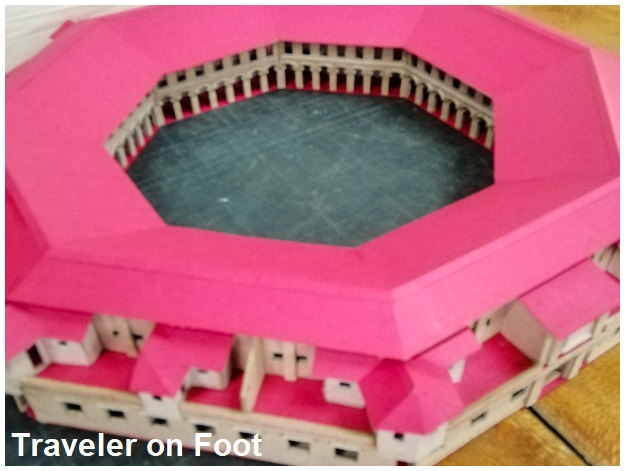
18TH CENTURY SILK MARKET. P. Guevara Elementary School is the site of a large octagonal building known during the 18th century as the Real Alciacera de San Fernando. Like the modern day department store, it served as a one stop shop for the Chinese community. It was a wholesale warehouse mainly for silk, and at some point a custom and immigration house. It was also a residential space for transient Chinese. The structure was abandoned after it was razed by fire in 1850 until a school was built from its ancient foundation.
During the school’s recent renovation, the silk market’s original marker that details its dedication, policies, completion year in 1762 were unearthed along with other artifacts. The piedra china marker was declared as a National Cultural Treasure and is in the care of the National Museum of the Philippines.
SHARDS FROM THE LAST DYNASTY. Whoever said that where history ends archeology begins can relate to how a classroom in P. Guevara Elementary was converted into a temporary display area for the artifact recovered from the diggings. Most of the objects on display were ceramic shards from the last Chinese dynasty or Qing Empire that ruled China from 1644 to 1912.
Porcelain and ceramic ware from China upon its arrival in the country became a prized ceremonial and heirloom object especially in a crude pottery culture. Ifugaos used heirloom jars in ritual feasts. It became a status symbol among lowland principalia to use Oriental porcelain as tableware. The hunt for antique Oriental ceramics became so popular and plentiful in the 1970s in digging around Pila, Laguna, Calatagan, Batangas, Oton, Cebu and Butuan in Mindanao. 800 year old ceramic from the Sung and Yuan dynasties, celadon porcelain and Ming dynasty ceramic plates with blue freehand paintings are sought after in the antique trade. Most of the Chinese ceramics recovered from the diggings around the country were grave furniture since they were retrieved from ancient burial sites. The ones excavated from the alciaceria were used in wholesale trade.
UNEARTHED ARTIFACTS. More random objects were retrieved from the diggings in the ancient silk market, including parts from its former architecture. Clear and tinted glass bottles, some with embossed label from prewar Botica Boie in Escolta. There were clay bricks with engraving of it manufacturer’s name. Interesting display were charcoal and melted iron debris from the 1850 fire that decommissioned the alcaiceria.
An iron cast bell dated 1938 from a Japanese fishing boat was believed to have found its way to the alcaiceria when the Japanese Imperial Army used the site as garrison during the last world war.
WILVEN INFANTE. The diggings are ongoing along with the construction of new buildings for the school. Artifacts from the ancient silk market continue to surface. The job of gathering, documenting, protecting and putting together a museum dedicated to the archeological finds fell in the hands of grade school teacher, Wilven Infante.
With little or no help from the local government, our culture hero painstakingly together with a trustworthy team of construction workers who are untrained to handle archeological artifacts retrieve and carefully handle these heritage objects. For heritage champion Stephen Pamorada, ‘there is a need for a comprehensive archeological retrieval system in place to ensure the protection of all his finds.’ All of us present in the walking tour agreed to that Wilven is entitled to received recognition but also he must be fairly compensated for his efforts.
ILANG-ILANG RESTAURANT. It was my first time to be in San Nicolas at dusk when activities in the busy warehouses and storefront shops gradually slowed down. Our team found ourselves resting in a restaurant named after the narrow Ilang-Ilang Street. The street was named after the old time factories that extracted scented oils from the tropical flower used in the mixing of French perfumes.
Rache informed us that the restaurant have been in the catering business since 1910 and still thrives even during this pandemic season because of its reputation for serving time-honored recipes. She continued sharing about heirloom dish she learned while helping her grandmother prepare them without having to write down the ingredients and the process in cooking them. It’s a family culinary practice prescribed by her ancestors and both her paternal and maternal side have different ways of preparing the same dish. She laments how standardization of dishes would kill family culinary traditions.
EPILOGUE: ORIENTAL ROOTS. To cap our walking tour, the rest of us went to Cafe 1919 that is housed in a prewar building along Juan Luna Street for dessert and coffee.
This walking tour around San Nicolas District gave all of us the opportunity to become informal historians, archeologists, and anthropologists by putting together shards of discoveries, stories and insights gathered from this tour into an assemblage of our Oriental roots.
A QUICK TRIP DOWNTOWN. I miss doing random walking tours. The health risk brought by the fatal virus limited travel only to get the essentials. In one of my trips to downtown Manila, I was able to squeeze in between errands a cultural walking tour around its heritage district.
The term downtown Manila is hardly used in our contemporary time and depending on the period in our history, the title downtown shifted from Binondo to Sta. Cruz and then to Quiapo.
PLAZA CALDERON DE LA BARCA. In the mid-19th century, downtown Manila would be Plaza Calderon Dela Barca in Binondo and San Nicolas District. This open space was named after a Spanish playwright and has changed names several times. The historian Teodoro Agoncillo described Plaza Calderon dela Barca as one of the most impressive open spaces of old Manila. It was landscaped with trees, Rococo water fountains on each end, and it was surrounded by equally impressive buildings, Hotel de Oriente and La Insular Cigar Factory.
We can only imagine these structures illustrated in old prints as an assemblage of architectural styles from Neo-Mudéjar to Belle Époque. Both buildings designed by the Spanish architect Juan Jose Huervas y Arizmendi were casualties of fire and World War II. What remain of the glorious days of Plaza Calderon dela Barca are the twin fountains and Binondo Church.
GLORY DAYS OF THE MUELLES. At the end of Calle Rosario in today’s Quintin Paredes Street is the site of Puente de España. It was replaced after the war by the recently refurbished Jones Bridge with its faux-Belle Époque lamposts and restored allegorical sculptures from its pre-war Juan Arellano-design reincarnation.
A view from the bridge is a cluster of pre-war buildings Edificio El Hogar Filipino and First National City Bank along Muelle de Industria. The thriving trade along the wharves led to the construction of warehouses and office buildings in the neo-classical and beaux arts architecture that were fashionable during the 1910s.
FUENTE DE CARRIEDO. During the American era the bustle of business would shift from Binondo to Sta. Cruz. Before the Lacson statue was erected, Plaza Goiti was the center of the city’s transportation network, where the tranvias ferried commuters to old Manila‘s major thoroughfares. The gentry and businessmen gathered to share the latest news before it broke on the porticos of the Neo-Classical Roman Santos Building where President Manuel Quezon worked as a clerk before starting his political career.
Plaza Sta. Cruz was center for entertainment like bars and vaudeville. The centerpiece of the Plaza Sta. Cruz is the 19th century Carriedo Fountain, which honors the legacy of philanthropist Don Francisco Carriedo y Perredo who left in his will the establishment of the first waterworks system for Manila. During my quick walking tour, I was able to say a prayer before the centuries-old image of the Nuestra Señora del Pilar in Sta. Cruz Church. Took a selfie in the Carriedo Fountain with the Monte de Piedad building in the background.
JAZZ AGE ESCOLTA. Across the street from the right side of Sta. Cruz Church is Calle Escolta, the country’s premier shopping destination during its heyday in the 1930s jazz age. Standing proud sentinels at the entrance of Manila’s historic high street are the Art Deco First United Building and the Beaux-Arts Regina Building.
I walked inside the pre-war First United Building to check out the retail stores with bespoke and artisanal products. One store sells original merchandise from pre-war Berg’s Department Store. I had a cold brew coffee while jazz music is being played in The Den.
EPILOGUE: ISANG SAGLIT IN PLAZA MIRANDA. In less than two hours of walking and doing errands, I ended up in Plaza Miranda. After the war, Downtown Manila was Plaza Miranda and all the streets leading to it. The transformation of Quiapo from a genteel arrabal to a rugged downtown began when the Friday devotions to Black Nazarene intensified to a city wide cult among the masses.
Later on, Plaza Miranda became a crossroad where political debates were staged and the people judged who to elect as leaders of the nation. The popular history, iconic landmarks and relevance of Quiapo to daily commuters and its street vendors, earned its enduring title up to this day as Downtown Manila.
ANGKAS WITH JOE. I knew that I will be spending a great time in Negros Occidental when I saw patches of cotton-like cumulus clouds around Mount Kanlaon from the window seat.
Touchdown. A welcome party awaited me in Silay Airport led by Roedil Geraldo. This Negrense artist is fondly called by his friends and in art circles as Joe. He is the sculptor known to source the main material for his wild terracotta figures from termite mounds and would bake them applying the ancient way of open-fire method.
PINTURA NEGRENSE. A month before this trip, Joe and I planned out this four-day Negros odyssey to make sure that my itinerary covers more than just historic and heritage sites but also visits to artist’s studios. From Silay Airport, we sped off on two motorbikes en route to Victorias to view Alfonso Ossorio’s Angry Christ. Like riders in tandem, our little motorcade revved on. As a skilled biker, Joe zoomed on good roads that cut through the immense cane fields of the Sugarlandia and raced against trucks loaded with sugarcane.
By noontime, we were out of the cane fields and entered cosmopolitan Bacolod City where Joe introduced me to iconic Negrense artists. The bold colors, radical themes, and inherent angst that transform rural images and social issues into diverse expressionistic styles are present in the home studios of Charlie Co, Rodney Martinez, Rafael Paderna, and Jecky Alano.
GERALDO’S MIDDLE EARTH. I was first introduced to Joe’s works in Pinto Art Museum where his terracotta sculptures from his Yakap series are part of the museum’s permanent exhibit. I was immediately drawn to his surreal stylized figures that recall Tolkien’s characters from Middle Earth only that these are Joe’s peculiar but honest criticisms on human values and behaviors.
In 2016, I was able to save up for a piece from the same series, which I got from Kaida Contemporary and another of his early work from an antique shop in Ermita. Later that year, I invited Joe into our home where he brought in a Bayanihan sculpture and a terracotta mask. I can retell the story of each piece as were narrated to me by the artist that made them but the storytelling and art became overwhelmingly exciting when it was my turn to visit Joe in his atelier in Talisay City.
EPILOGUE: GARDEN OF EARTHLY DELIGHTS. For my first two days in Negros, I stayed in Joe’s three story home studio where any visitor would immediately get the impression that the artist wanted his sculptures to be viewed alongside each other in his atelier.
Each floor is filled with his terracotta sculptures and the exhibit spills to the roof top garden where my room is set to enjoy all these earthly delights.








 Traveler on Foot